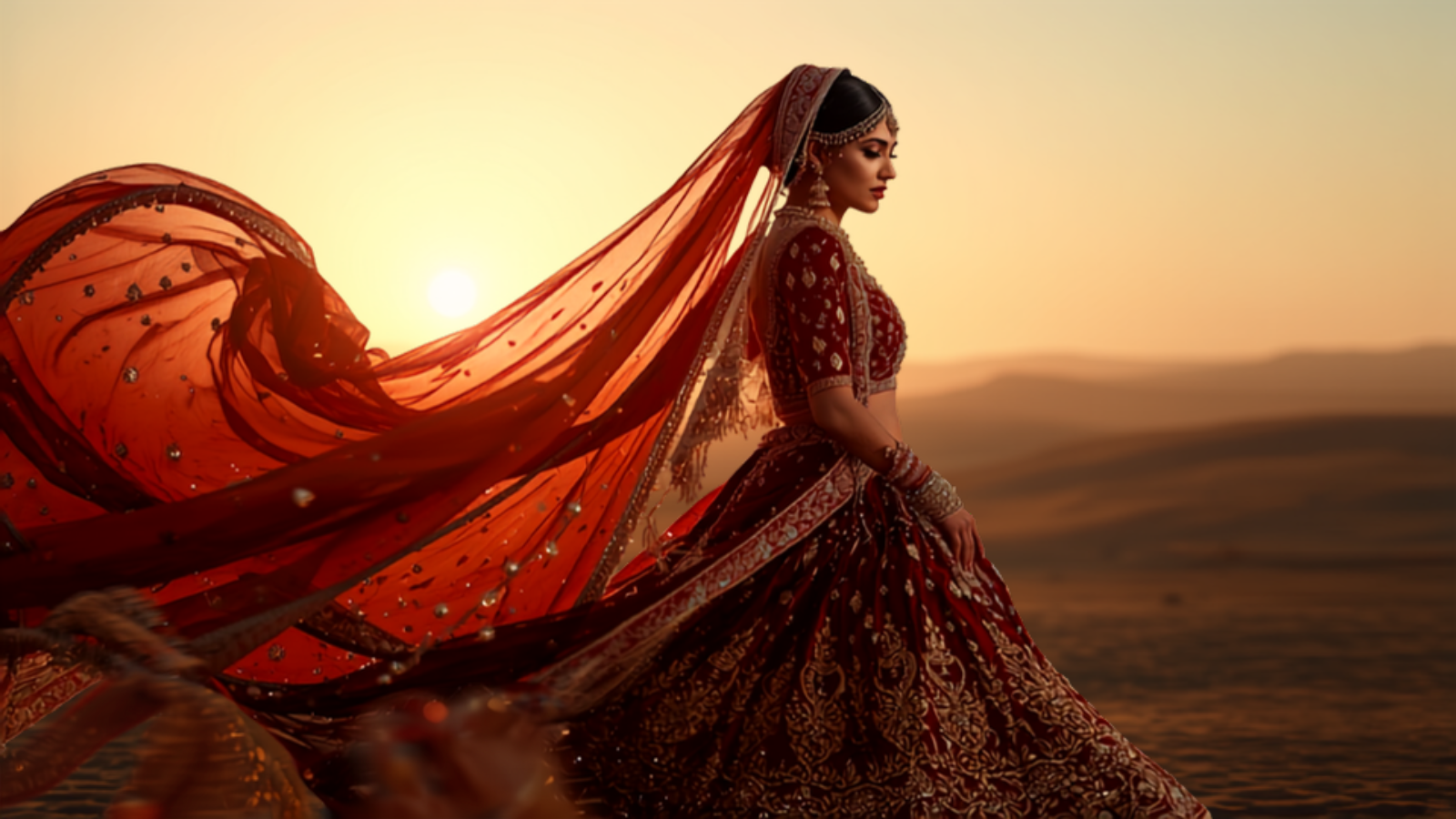
A bride sat cross legged on the floor of my studio last month, rehearsing her phere posture in a lehenga we had not yet finished pinning, and within thirty seconds her dupatta had slid clean off one shoulder. She looked up at me, half laughing and half panicked, and said, "Is this going to happen at the mandap." That question is the whole job, really. Not "does this look beautiful in the mirror" but "does this survive the day it was built for."
I have been styling brides long enough to know that a lehenga is not one outfit. It is at least three, depending on what the body is being asked to do in it. The same silhouette that looks sculptural standing still can betray you the second you sit, bend, twirl, or stand for four hours straight greeting two hundred relatives. My brides rarely think about this until it is almost too late, because bridal shopping happens in a boutique mirror under good lighting, where nobody asks you to fold your legs or raise your arms over your head. Styling for how the day moves, not just how the photograph looks, is the part of this work that never makes it onto Pinterest, and it is exactly where I earn my keep.
The Phera Body: Styling for Stillness
The pheras ask for something counterintuitive: total stillness that still needs to look effortless. You are seated, often on the floor or a low platform, for anywhere between twenty minutes and over an hour depending on your priest and your rituals. Everything that moves while you sit is a liability. A heavily pleated lehenga with too much volume in the front will bunch awkwardly across your lap. A dupatta pinned only at the shoulder will slide the moment you lean forward for the agni.
This is where I push my brides toward the jacket-style lehengas that are having such a strong moment in 2026: a structured, often mirror-worked jacket layered over a lighter skirt gives you a torso that holds its shape without a single loose drape to manage. If a dupatta is part of the look, I double pin it, once at the shoulder and once discreetly at the waist, so it has nowhere to travel even when you bend toward the fire four separate times. I also always ask my brides to rehearse sitting in the actual outfit, not a similar one, at least once before the wedding morning. It sounds obvious. Almost nobody does it, and it is the single fastest way to catch a problem while there is still time to fix it.
The Sangeet Body: Styling for Movement
The Sangeet is the opposite brief entirely. You need to dance, sometimes a choreographed number you have been rehearsing for weeks, and the outfit has to move with you rather than against you. This is where I am steering almost every bride toward the column and A line silhouettes that are quietly replacing the stiff, heavily structured lehenga skirts of a few years ago. Lighter fabrics, organza, tissue, fine net blends, catch movement and light in a way raw silk simply cannot, and they weigh a fraction as much, which your shoulders and your stamina will thank you for by hour three.
The Stylist's Touch: for a Sangeet look I favour focused embroidery, a heavily worked border or bodice, rather than all over embellishment, because dense work across an entire skirt adds weight exactly where you need freedom. Zarkan and mirror work are everywhere this season for good reason: they catch stage lighting beautifully while staying relatively light per inch of fabric compared to dense zardozi. And I almost never let a dancing bride wear a dupatta pinned at both shoulders in a way that restricts arm movement. Better a detachable cape or a dupatta that can be handed off mid function than one that fights you through your own choreography.
The Reception Body: Styling for Hours on Your Feet
Reception is its own physical event: hours of standing, greeting, photographs, minimal sitting. Here the priority shifts to support and structure that can hold up over time without you having to think about it. A well boned, corset style blouse earns its keep here, not for the silhouette alone but because it genuinely holds your posture up when your body is tired. I also pay close attention to hem weight at this stage. A skirt with a slightly weighted or beaded hem falls beautifully and stays put through hours of movement between tables, instead of shifting or riding up with every step.
The Aesthetic: Where 2026 Is Making This Easier
The wider trend story this year is doing my brides a favour. Colour has genuinely opened up beyond the expected reds: I am styling a lot of pistachio and sage green right now, alongside champagne, muted gold, and the deep jewel tones of emerald and wine for evening functions. Fabric-wise, the shift toward organza, tissue, and lighter silk blends over stiff raw silk is not just an aesthetic choice, it is a comfort one, and it plays directly into everything above about styling for movement. Even the blouse has become the hero piece this season, with curved necklines and boned bodices doing real structural work rather than sitting there as an afterthought under a heavy dupatta.
Here is what I want every bride to walk away with before her first fitting:
Ask your designer what the outfit does when you sit, not just when you stand
Rehearse your actual wedding look, including jewellery, in a full run through of your day's movements
Choose lighter fabrics like organza or tissue blends for any function involving dancing or long standing
Save your heaviest, most structured piece for the function where you will move the least
Double pin any dupatta that needs to survive bending, sitting, or dancing
Consider a detachable jacket or cape so one base lehenga can serve two very different functions
The SGK Philosophy
This is the part of styling I love most, because it is where craft meets real life. Anyone can find you a beautiful lehenga. My job as the Creative Director of your wardrobe is to make sure that beauty survives contact with an actual wedding day, with its rituals and its dance floors and its four hours of standing in receiving lines. A bride who has been styled for movement does not think about her outfit at all on her wedding day. She just moves through it, and that is exactly the point.
If you are starting to plan your wedding wardrobe and want to think through it function by function, I would love to talk. Reach out for a consultation whenever you are ready, there is no rush, only good conversation about how your day is actually going to unfold.
With love and style,
Shreya Gupta Kedia
Founder, SGK Styles


