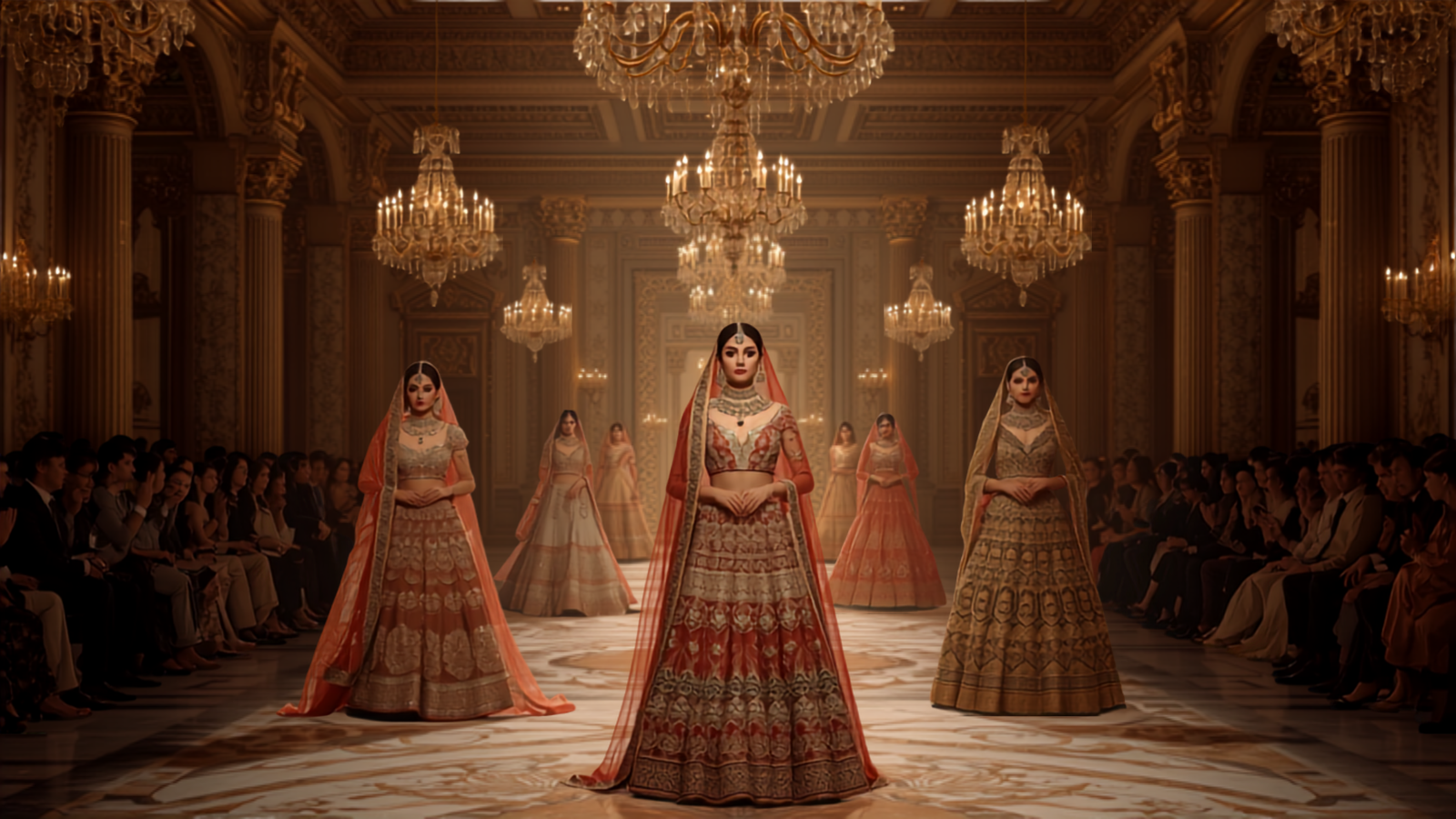
Today, for the first time in its nineteen editions, India Couture Week does not open in Delhi. It opens inside Falaknuma Palace in Hyderabad, with Anamika Khanna presenting a collection built around memory, craftsmanship and a kind of lost civilisation she has reimagined through womenswear and menswear. By the time you read this, the week will already be moving toward its usual home at Taj Palace in Delhi, where Falguni Shane Peacock, Tarun Tahiliani, Arpita Mehta, Masaba and Kunal Rawal will each take their turn on the runway before Rahul Mishra closes the season on July 29.
I have watched a lot of couture weeks from the front row and from behind a client's shoulder, helping her decide what she is actually seeing. And every year, someone asks me the same question backstage or over coffee the next morning: does any of this actually matter to a real bride getting married in her hometown, not on a runway? My answer has not changed in ten years of styling. It matters enormously, just not in the way people assume.
The Front Row Is Never Just Fashion
People think a front row is about who is sitting next to whom, or which actress wore what. I promise you, as someone who reads a front row for a living, it is about something quieter than that. It is a room full of people deciding, collectively, what beauty is going to mean for the next twelve months. The silhouette that gets the loudest applause in that room in July is very often the silhouette my brides will ask for by December.
That is why a couture week opening in a five hundred year old palace instead of a hotel ballroom is not a logistics story. It is a statement about where Indian couture wants to locate itself: closer to heritage, closer to architecture that has already survived centuries, further from anything that feels temporary or trend-driven. If you are planning a wedding wardrobe right now, that shift is worth paying attention to. The most sought-after looks this year are not the loudest ones. They are the ones that feel like they belong somewhere old.
What Anamika Khanna's Opening Really Says
Anamika Khanna is one of the few designers who can put a dhoti, a cape and a corset in the same silhouette and make it feel inevitable rather than experimental. Her opening collection for this edition is built around an imagined lost civilisation, told through recurring archetypal figures across both womenswear and menswear. It is a big, poetic idea for an opening show, and I do not think that is an accident.
Here is the stylist's read: when a designer chooses memory and craftsmanship as her subject, she is telling the industry that couture in 2026 has moved past spectacle for its own sake. My brides who come to me overwhelmed by trend cycles are often relieved to hear this. The instruction from the top of Indian fashion right now is not "wear something new." It is "wear something that could have existed in another century and still feel like you." That is a far more generous brief, and a far more wearable one.
The Aesthetic: A Week Built on Range, Not Repetition
The vibe of this entire edition, if you look at the full lineup, is deliberate range rather than a single dominant trend. Falguni Shane Peacock will bring their signature maximalism and drama to Delhi the day after the Hyderabad opening. Tarun Tahiliani, always the master of drape and heritage silhouette, will show alongside Arpita Mehta, whose mirror work and festive colour have made her a Sangeet favourite for real brides for years now. Masaba will bring her print led, unapologetically modern point of view, and Kunal Rawal will hold down the menswear conversation with the kind of tailored ease that has redefined what a groom is allowed to want. Rahul Mishra closing the week on the 29th, with his hand embroidery and nature motifs that have already made him a name on international runways, gives the whole season a soft, artisanal landing.
The stylist's touch here is to notice that none of these are competing aesthetics. They are five different answers to the same question: how do you make heritage feel personal instead of costume-like. That question is exactly the one I sit with every time I start a bridal consultation.
Translating Couture Week to Your Own Wedding
You do not need a front row seat at Falaknuma Palace to use any of this. What you need is a stylist's eye for which parts of a season are actually useful information and which parts are just noise. Here is what I would tell a bride sitting across from me this week.
Choose a designer's philosophy before you choose their most photographed piece; a silhouette borrowed without the idea behind it rarely photographs as well on you as it did on the runway.
Let heritage venues and heritage textiles talk to each other. If your wedding is in a haveli, a fort or an old palace hotel, dress for the architecture, not against it.
Treat menswear as equally worthy of a point of view this season; the Kunal Rawal effect has made tailored, considered grooms the norm, not the exception.
Ask for craftsmanship stories, not just fabric names. Zardozi, gota patti and hand embroidery all carry different weights of formality and should be chosen to match the moment, not just the mood board.
Resist the urge to chase every trend from every show. Pick the one idea from this season that actually sounds like you, and build your wardrobe around that single thread.
The SGK Philosophy: Your Wedding Is Its Own Couture Week
This is the part of my job I love most: taking something as vast and as far away as a runway show inside a Hyderabad palace and translating it into a wardrobe that feels entirely, unmistakably yours. I am not interested in dressing you like a runway look. I am interested in using the runway as a conversation starter for a much more personal question: who are you becoming as you step into this new chapter, and what does she wear.
That is the real work of a Creative Director of your wardrobe, which is how I think of my role with every bride I take on. I watch the couture weeks so you do not have to sit through six days of runway shows to find the one idea worth keeping. If any of this, the Hyderabad opening, the craftsmanship conversation, the range across this year's designers, has you curious about what it means for your own wedding wardrobe, I would love to sit with you and figure it out. Come find me and let's talk about your Style DNA.
With love and style,
Shreya Gupta Kedia
Founder, SGK Styles


