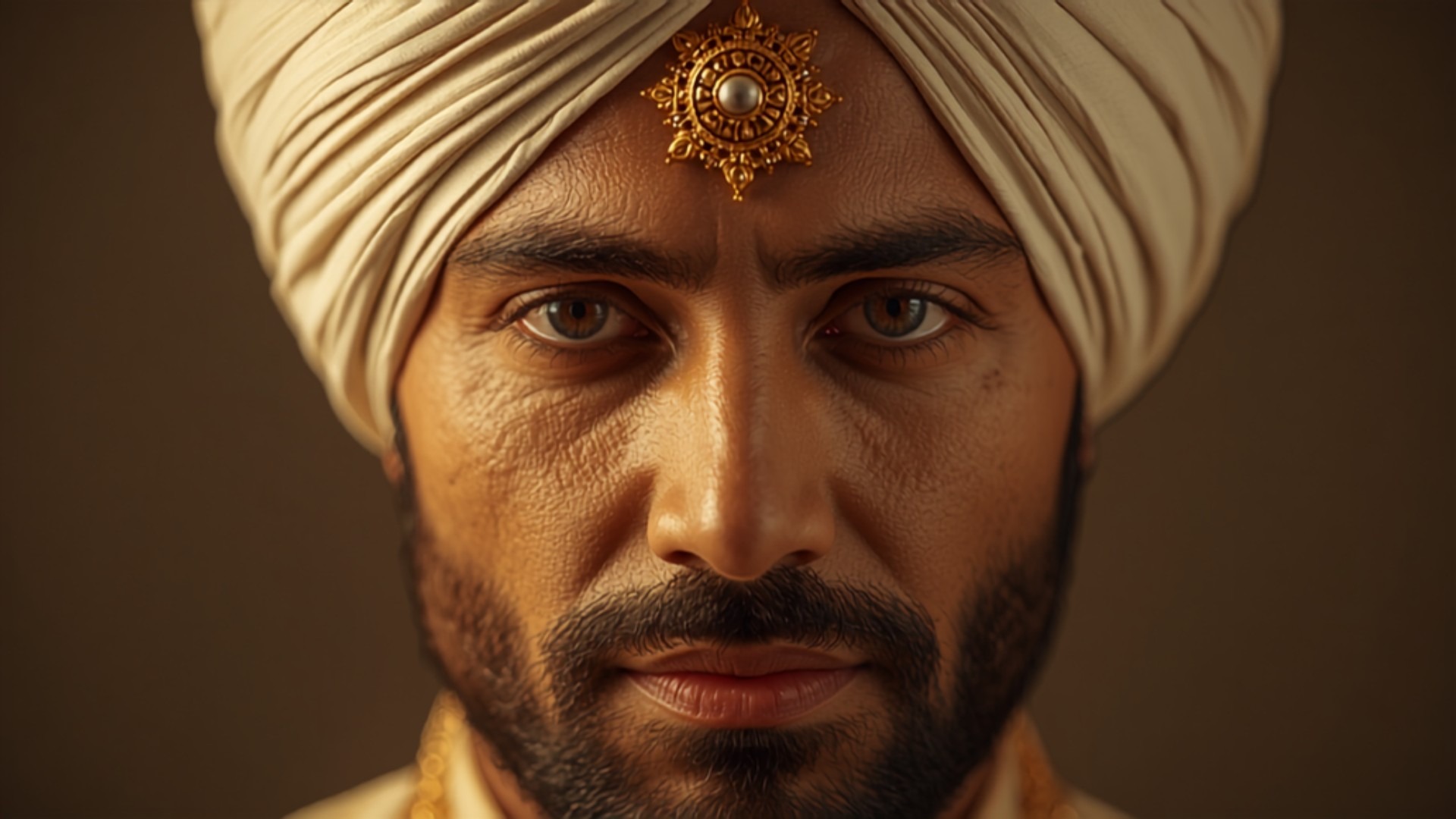
A groom I dressed last month looked at the kalgi in my hand and said, "Isn't that a bit much?" He was standing in an ivory sherwani so quietly beautiful it barely needed a second look, and here I was asking him to pin a feathered, kundan-studded ornament to his safa. He put it on anyway, mostly to humour me. Then he saw himself in the mirror and stopped talking. That is the moment I live for as a stylist: the second a man realises the missing piece was never optional, it was the whole point.
For a few seasons, groom styling in India has been on a restraint kick. Reds gave way to ivories, heavy zardozi gave way to raised threadwork you have to catch the light just right to see, and a lot of my consultations started with some version of "I don't want to look like I'm trying too hard." I understood that instinct, and I still respect it. But somewhere in the last year, the pendulum found its way back to the one accessory that has always separated a groom from a guest: the ornament on his head. Sarpech, kalgi, whatever your family calls it, it is having a real moment again in 2026, and I think it is worth talking about why.
The Aesthetic: Minimal Sherwani, Maximal Crown
This season's groom silhouette is cleaner than it has been in years. Ivory, sage and muted gold sherwanis dominate the order books at every atelier I work with, alongside bandhgalas in powder blue, pistachio and champagne for the more Indo-western among my clients. The embellishment has quietened down too: geometric quilting, tone-on-tone zardozi, structured drapes that read as architecture rather than decoration. It is beautiful, but on its own it can read a little safe, almost interchangeable from one groom to the next.
The kalgi is what breaks that sameness. Historically it was reserved for kings and the men in their courts, a literal marker of rank pinned to the turban, sometimes with a long feather standing tall the way it would on a royal crest. What I am seeing this year is a return to that idea, minus the theatre. My clients are not asking for the six-inch, fully encrusted showpiece their grandfather might have worn. They want something sleeker: a compact kundan or polki sarpech, maybe one modest feather instead of three, sitting close to the safa rather than towering off it. It is a nod to heritage that a 32-year-old in a well-tailored sherwani can wear without feeling like he raided a museum.
The Stylist's Touch: Building the Safa Around the Man, Not the Other Way Round
Here is where I actually earn my fee. A safa is not a hat you plant on someone's head fifteen minutes before the baraat. The drape, the pleating, the tilt, all of it changes how a kalgi sits and whether it looks like it belongs there or was clipped on as an afterthought. I always start with the face and the neckline of the sherwani, then work backward to the turban style: a Rajasthani-style safa with sharper pleats suits a more angular face and pairs beautifully with a slimmer sarpech, while a rounder Punjabi-style pagri gives you room for something a touch more ornate.
Colour coordination matters more than people expect. If the bride's dupatta or veil has any gold or antique polki work in it, I try to echo that metal tone in the groom's kalgi rather than matching it exactly, because a family that reads as coordinated without being matchy always photographs better than two people in identical gold. And if there is a family heirloom sitting in a locker somewhere, I will always ask before recommending a new piece. Half my favourite kalgi moments this year involved a great-grandfather's sarpech reset with a fresh feather and a cleaner mount. That kind of continuity is worth more than anything you can buy new.
The Vibe: Confidence Without Costume
What I keep telling grooms who are nervous about "too much" is that a kalgi does not compete with a minimal sherwani, it completes it. The whole appeal of this season's pastel, texture-forward menswear is quiet confidence, and there is nothing quieter or more confident than a man who is comfortable being looked at on his own wedding day. The safa and its ornament are the one place in a groom's wardrobe where tradition gets to be loud while everything else stays composed. I have started referring to it with my team as the exclamation point at the end of an otherwise very calm sentence.
This is also, practically speaking, one of the more forgiving parts of building a groom's wardrobe. Unlike a sherwani, a kalgi can be rented, borrowed, restyled or swapped between events without anyone re-fitting anything, which makes it an easy way to shift the mood between a daytime pheras look and a more festive sangeet or reception moment.
Here is what I tell every groom who is on the fence about wearing one:
Choose a compact, close-set kalgi over an oversized one if this is your first time wearing a safa, it reads as confident rather than costumey.
Match the metal tone of your kalgi to your bride's jewellery, not necessarily to your own buttons or brooch.
Ask your family first before buying new. An heirloom sarpech reset for you is almost always more special than a fresh purchase.
Have your stylist or turban tier finalise the safa drape before the kalgi is pinned, the angle changes everything.
Save the more elaborate piece for the wedding day itself and let the sangeet or reception safa, if you wear one, stay simpler.
Practice sitting, greeting guests and walking in the full safa and kalgi at least once before the day. Comfort shows on camera.
Why This Matters to Me
I built SGK Styles on the belief that every person walking into their wedding deserves to feel like the most fully realised version of themselves, and for grooms that often gets overlooked in favour of the bride's wardrobe. But the men I dress remember exactly how they felt the moment they saw themselves fully put together, kalgi and all, and that feeling is not vanity. It is recognition. It is a man understanding, maybe for the first time, that he is not just accompanying the bride down the aisle, he is also someone's whole reason for dressing up.
If you are building your own wedding wardrobe for this coming season and you are unsure whether a piece like this belongs in it, I would love to talk it through with you. Some of my favourite conversations start with a groom telling me he does not need any of this, and end with him asking where I sourced the feather.
With love and style,
Shreya Gupta Kedia
Founder, SGK Styles


