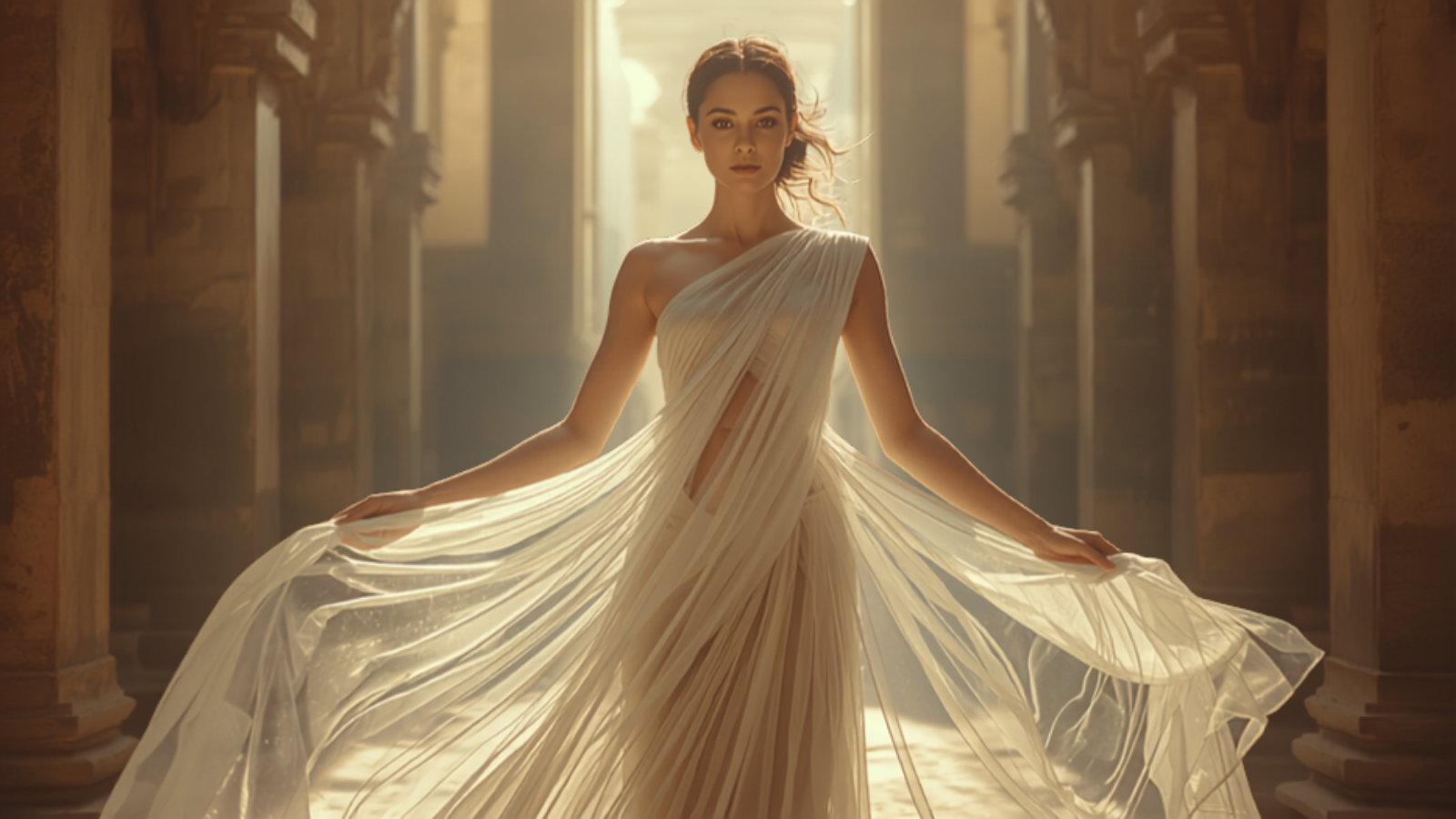
A bride sat across from me last week and said something I hear more and more: "I don't want to feel like I'm wearing armour on my wedding day." She had tried on three heavily structured lehengas, each one beautiful, each one making her stand a little stiffer, breathe a little shallower. Then we put her in a draped sari-gown with a cape dupatta and she exhaled. That exhale is the whole trend story of this coming season.
For years, Indian bridal fashion has rewarded structure: boning, layering, weight, the sheer physical presence of embellishment. That is not disappearing, but it is being joined, and in many wardrobes overtaken, by something softer. I am calling it the Goddess Shift, and if you are planning a wedding for the season ahead, it is worth understanding before you walk into your first appointment.
The Aesthetic: Fluidity as the New Flex
The look leans into Greco-Roman drape lines translated through Indian textile logic: pre-stitched dhoti sarees, cape-style lehengas that fall from the shoulder instead of the waist, and asymmetric pallus that move when a bride walks rather than sitting frozen in one pleat. Designers are pairing this with a colour story that has genuinely shifted from the deep reds and maroons that dominated the last several seasons. Think sage green, butter yellow, dusty rose and blush for daytime functions, and then deep emerald, sapphire and burnt sienna for the evening ceremonies where you want richness without heaviness.
The stylist's touch here is knowing that drape is not the same as effortless. A cape lehenga that falls beautifully in a fitting room can go wrong in front of two hundred guests and a videographer if the fabric weight is off by even a little. I always ask for a full weighted mock-up before we commit, because georgette drapes differently in July heat than it does in a cool December evening, and your wedding date should genuinely dictate your fabric choice, not just your colour board.
The Vibe: Ombré, Not Ornament
Ombré lehengas are having a real moment, and they pair naturally with this softer draping story. Instead of one saturated shade from hem to waist, you get a gradient, often starting deep at the border and lifting to a whisper of colour near the waist, which does something wonderful for outdoor and golden-hour ceremonies. It photographs like movement even when the bride is standing still.
What ties the whole look together is the dupatta, which has quietly become the most important single piece in a bridal ensemble again. Sheer tulle and organza dupattas, finished with hand-placed crystals rather than dense zardozi, are doing the work that heavy embroidery used to do. A nath, a soft gajra, and a dupatta that catches light when you turn your head can carry an entire look, which is a very different bridal philosophy from five years ago when more embellishment always meant more impact.
The Stylist's Touch: Building the Blouse as the Anchor
Even inside this fluid, draped movement, the blouse has stayed the hero piece, and that has not reversed. Corset-style fits, curved necklines and boned bodices are still doing quiet structural work underneath the soft drape on top, which is actually the smartest engineering trick of this whole trend. You get the visual softness of fabric in motion while the blouse gives your silhouette the support and shape that keeps you looking put together for a fourteen-hour wedding day. When a bride tells me she wants "effortless," what she usually means is she wants it to look effortless. The blouse is where I build the actual effort.
For Sangeet and Mehendi, I have been pulling clients toward lighter cape dupattas over simple lehenga skirts or even palazzo sets, which lets them dance without fighting fabric. Save the fully structured, embroidery-forward pieces for Phere and reception, where you are seated or standing for photographs and structure reads as intention rather than restriction.
Practical Takeaways for Brides Building Toward This Look
Ask for a weighted fabric trial before finalising any drape-heavy silhouette, since georgette, chiffon and crepe all fall differently in heat versus air conditioning.
Choose your embellishment intensity by function: sheer, crystal-detailed dupattas for daytime and Mehendi, richer embroidery reserved for Phere and reception.
Let the blouse carry structure so the rest of the outfit can move freely; a well-boned corset blouse is not optional, it is what makes soft drape look intentional.
Consider an ombré lehenga if you are marrying outdoors or at golden hour, since gradient colour reads beautifully in natural light in a way flat colour does not.
Do not skip the dupatta styling session. How it is pinned, draped or left loose changes an entire silhouette more than people expect.
The SGK Philosophy
I always tell my brides that a wardrobe is not a costume, it is an extension of how you want to move through the most important day of your life. This season's shift toward fluid draping feels less like a fashion cycle and more like a correction: brides asking for clothes that let them dance at their own Sangeet and breathe through their own vows. That is the job I take seriously as the Creative Director of your wardrobe, matching craft and comfort so nothing about your day feels like it is wearing you.
If you are building your wedding wardrobe for the season ahead and want to talk through silhouette, fabric weight or how to sequence structured and fluid pieces across your functions, I would love to have that conversation with you. Come sit with me, bring your inspiration board, and let's build something that moves the way you do.
With love and style,
Shreya Gupta Kedia
Founder, SGK Styles


